


This September, Parallax has been in business for 35 years. As part of our celebration, we asked our customers to tell us your Parallax story. This is one we received from our community which will be shared throughout the month.
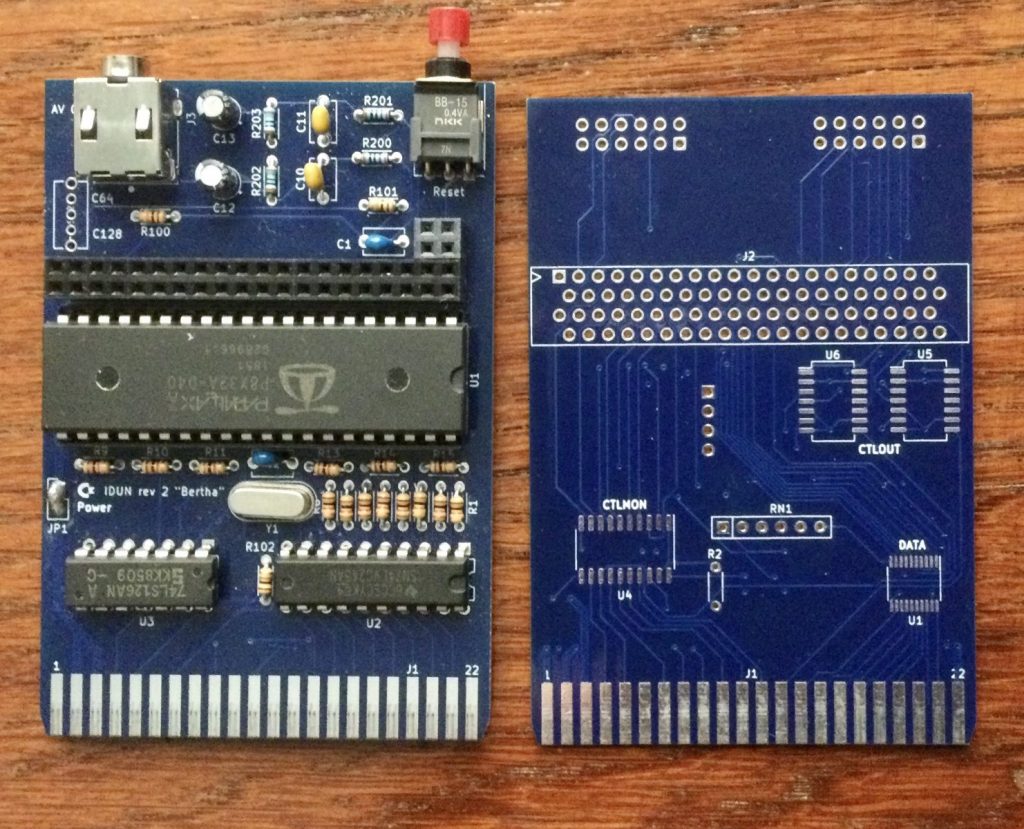
As I was unpacking my latest prototype printed circuit boards, which I designed a few weeks ago around the Parallax Propeller 2, I received your e-mail regarding Parallax’s 35th Anniversary. This caused me to reflect on the “bookends” of my own journey in tinkering with computers, and the corresponding influence that Parallax, and Chip’s creations, have had on me.
In 1985, I was a high school senior who was very enthusiastic about computers. I had been a blossoming young amateur programmer for a few years, cutting my teeth (as they say) on the school’s TRS-80 micros, as well as my own Commodore C64. I can still remember when I picked up a C64 magazine that Summer and had my first encounter with a new product called ISEPIC. My thoughts at the time were “How the heck is that possible?” and “Is there anything this little computer can’t do?”. Both thoughts gave me inspiration at the time for my own journey to master the computer in front of me. With this foundation, I would go on to first run a BBS out of my bedroom on that same C64, equipped with an ISEPIC cartridge! This amazed me and my friends, as well as triggering the start of life-changing relationships.
Later, I would become a professional software developer, and enjoy that career for the next 30 years, which brings me to the other “bookend.” After ceasing full-time work, I decided to indulge my passion for computer hardware engineering and programming in assembly language. Both were always an interest of mine, but my professional career had been exclusively programming using high-level languages. Also, I still held fond memories of the enjoyment of learning about computers for the first time. So, I poked around the Internet and discovered this amazing little micro-controller from Parallax: The Propeller. I decided to learn PCB CAD, and have had a glorious time designing my own cartridge for the (new and more advanced) Commodore C128, also from 1985! I use the Propeller, some simple PASM code, a replacement C128 OS written in 6502 assembly, and some Rust server software, to allow my C128 to access data from SD cards, run new software written in Lua, access my Wi-Fi network, and even connect with BBS’s (via the Internet) like the one I ran out of my childhood bedroom. Now, I am updating my design to take advantage of the vast additional power and speed available with the Propeller 2.
So, you see, the products you have crafted are a direct cause of my most enjoyable personal computer learning experiences these last 35 years! Chip is so innovative, and both he and your company continue to inspire me today just as in 1985! I am still amazed, and still wonder, “Is there anything that Parallax can’t do?”
Best Regards,
Brian K. Holdsworth
Cary, NC
P.S. Above is a photo of two PCB’s I’ve designed recently, having been inspired to learn PCB design because of the Propeller 1 and 2. The populated PCB (left) is a 2-layer board using the P1 and other through-hole components. The unpopulated PCB (right) is my prototype for P2 development. It’s a 4-layer board, with the 80-pin connector “J2” used by a P2 edge module and the two 12-pin headers at the top for connecting accessory boards for video, USB, and PSRAM. In the future, I intend to modify this design to incorporate the P2 chip and accessories directly.