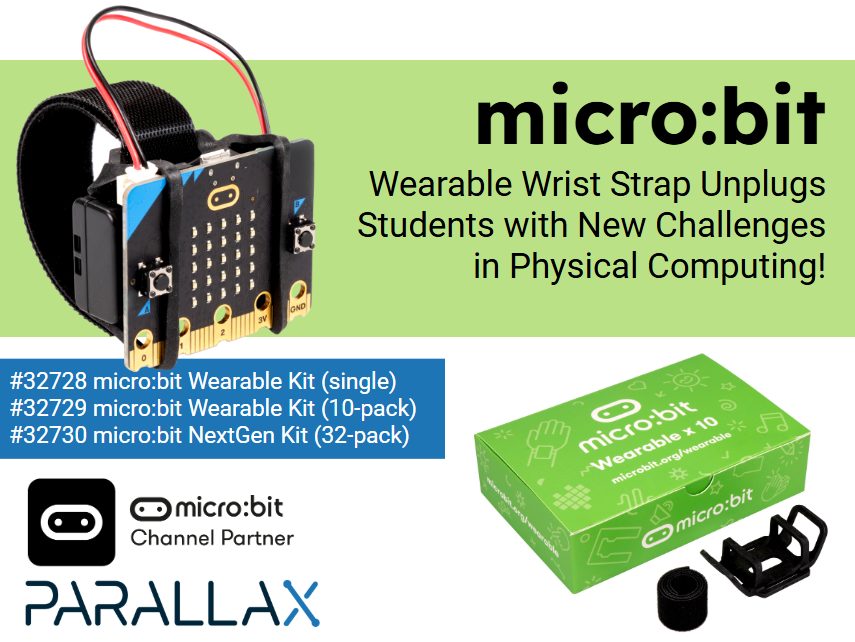
There’s a new product being released today! Well, at least we’re putting customers on the E-mail waitlist for the inventory arrival very soon (you can get a quote for school purchase orders by sales@parallax.com). The micro:bit Wearable Wrist Strap lets students detach themselves from the dreaded screen dependency with physical computing and total freedom to do all kinds of unplugged (or wireless) activities with their micro:bit. The micro:bit Educational Foundation has released a video showing how to use this new tool.
Soon, the internet will be full of examples and I think we can expect to see projects like the following (but hang on till the bottom for my grand challenges, since we need to ask more of our students):
-
Step Counter: Utilize the micro’s accelerometer to count your steps, similar to a pedometer. This project helps you understand motion detection and data logging.
-
Digital Watch: Create a simple digital watch that displays the time using the micro:bit’s LED matrix. This introduces concepts of timekeeping and display programming.
-
Rock, Paper, Scissors Game: Program the micro:bit to play this classic game by shaking it to generate a random choice. This activity teaches randomization and user interaction.
-
Fitness Tracker: Develop a basic fitness tracker that monitors physical activity levels. This project combines data collection with health education.
-
Compass: Use the micro:bit’s magnetometer to create a digital compass, displaying directions on the LED matrix. This introduces magnetic fields and navigation principles.
-
Gesture-Controlled Devices: Program the micro:bit to recognize specific wrist movements to control other devices or trigger actions, enhancing understanding of gesture recognition.
-
Morse Code Communicator: Send messages by converting text into Morse code signals, learning about historical communication methods and encoding.
-
Temperature Monitor: Measure and display ambient temperature, integrating environmental science with programming.
-
Music Player Controller: Control music playback on another device using the micro:bit’s buttons and radio functionality, combining media control with wireless communication.
-
Reaction Time Tester: Create a game that tests and displays your reaction time, blending gaming with cognitive science.
But you’re also going to need to challenge students with something really difficult. Something that you, as the educator, also have no idea how to achieve. Here are a few more ideas, which may or may not even be possible with the micro:bit module:
- cyber:bot Gesture Wireless Controller
- What it does: Use on-board sensors on the micro:bit (accelerometer, LEDs as light sensors) and Bluetooth radio to control the cyber:bot.
- Educational Benefit: Combines wearable tech with robotic control, wireless communication, and automation.
-
Personal Biofeedback System
- What it does: Uses additional sensors (e.g., pulse oximeter, GSR sensor) to measure heart rate, stress levels, or skin conductivity, providing real-time feedback to the user. Get out your soldering irons for this one.
- Educational Benefit: Combines wearable tech with health monitoring and introduces concepts like bioinformatics and data visualization.
-
Augmented Reality (AR) Gesture Controller
- What it does: Programs the micro:bit to serve as a motion controller for augmented reality devices devices, where specific wrist gestures manipulate virtual objects in AR games or simulations.
- Educational Benefit: Explores advanced motion tracking, wireless communication, and gaming or virtual reality integration.
-
Weather Reactive Wearable
- What it does: Syncs with online weather APIs (via a paired device attached to a computer) to display changing icons or patterns based on real-time weather data.
- Educational Benefit: Teaches IoT concepts, API integration, and environmental awareness.
-
Emergency Alert Wristband
- What it does: Combines the micro:bit with GPS and on-board accelerometer to create an emergency alert system that detects falls or collisions and sends out an SOS signal with location data.
- Educational Benefit: Provides practical experience in emergency systems, wearable safety tech, and GPS programming.
-
Wrist-Mounted Musical Instrument
- What it does: Converts accelerometer data into musical notes, allowing users to “play” music by waving their hand in different patterns.
- Educational Benefit: Introduces audio synthesis and creativity in user interfaces.
-
“Follow-Me” Autonomous Drone Controller
- What it does: Turns the micro:bit into a control beacon for an autonomous drone that follows the wristband’s position using radio signals and accelerometer feedback. There must be a micro:bit-enabled drone that you can put on the shelf as an enticement for students to do this project.
- Educational Benefit: Combines robotics, drone programming, and advanced wireless communication.
-
Haptic Feedback Navigation Guide
- What it does: Activates a vibration motor on the wrist to guide users to a preset destination, using the magnetometer and a step counter for basic indoor navigation.
- Educational Benefit: Real-world applications for accessibility and navigation systems.
-
Multiplayer “Escape Room” Controller
- What it does: Enables multiple wrist-mounted micro:bit modules to communicate wirelessly to solve cooperative puzzles in an escape room scenario.
- Educational Benefit: Develops teamwork, puzzle design, and real-time communication skills.
-
Time-Lapse Artist Assistant
- What it does: Tracks wrist movements over time to create a visual “time-lapse painting” of movement paths.
- Educational Benefit: Combines art with data tracking and visualization.
-
Wearable AI Companion
- What it does: Pairs the micro:bit with a cloud-based AI service to act as a conversational assistant, providing notifications, reminders, or simple conversational responses.
- Educational Benefit: Introduces wearable AI, natural language processing, and cloud computing integration.
-
Gesture-Based Prosthetic Controller
- What it does: Designs a project where wrist movements control a robotic arm or hand, demonstrating how prosthetics can be guided by intuitive gestures.
- Educational Benefit: Teaches biomedical engineering concepts, robotics, and human-machine interaction.
-
Wrist-Mounted “Escape Velocity” Simulator
- What it does: Gamifies wrist acceleration with a space-themed challenge—measuring how quickly you can “launch a spaceship” by moving your hand at high speeds.
- Educational Benefit: Introduces concepts of force, velocity, and acceleration in a fun and interactive way.
-
Live Environmental Mapping
- What it does: Attaches the micro:bit to a mobile vehicle and uses it to record environmental conditions (e.g., light, temperature) as it moves, then visualizes the data on a map.
- Educational Benefit: Combines geospatial mapping, environmental monitoring, and data science.
-
Wrist-Powered Digital Puppeteer
- What it does: Uses the accelerometer and buttons to control a virtual puppet on a paired screen in real-time, perfect for storytelling or theater projects.
- Educational Benefit: Develops skills in real-time interaction and creative coding.
-
Gamified Rehabilitation Tool
- What it does: Creates a system where specific wrist movements are turned into game inputs, helping users recovering from injuries engage in physical therapy through play.
- Educational Benefit: Blends gaming with health tech and biomechanical analysis.
You get the idea. Let’s challenge these students. Ask them to do something impossible, that we don’t know how to do ourselves.