


Dear Community,
Customers often ask what motivated Parallax founders, and how the business came to be. Growing up, our dad built us a room above the garage and gave us the following “toys”: soldering irons, model rockets, control-line glow fuel airplanes, scroll saws, Dremel tools, and fireworks. Saturday may have included a trip to RadioShack or the hobby store. Later we got some computers: a Timex Sinclair 100, Vic20, C64, and Apple 2. Chip stayed up for nights, days, and weeks, experimenting, inventing, and building things. Innovative Software Engineering (ISE) was born when he was in high school and classes were of little interest. This turned into Parallax. Fortunate, blessed and privileged we were.
Creativity gets fostered at home, in schools, through Makerspaces and mentors — and the earlier, the better, but it’s never too late! Hands-on agency at a young age makes good engineers like Parallax’s Jeff and Andy, especially when backed by a supportive community, and it ultimately fuels the economy with higher-paying, rewarding jobs. Whether someone gains the confidence to do their own plumbing or electrical or designs a product over a weekend, the evidence to me is very clear: it starts early, and we should support it.
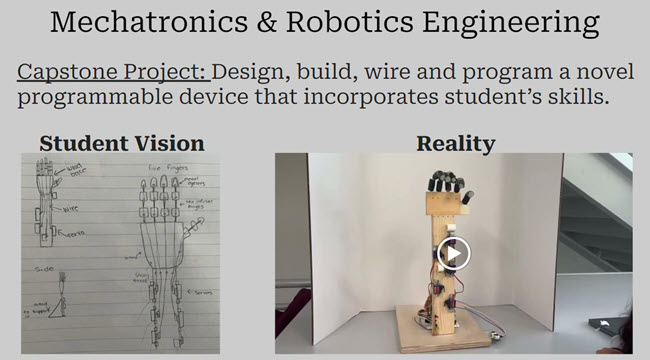
Today, one of the very best parts of working at Parallax is hearing back from teachers, and knowing what we do here helps to make a difference. Recently, Andrew Osterhaus, a mechatronics and engineering teacher from Alliance Marine Innovation and Technology School, shared a great presentation about his program and videos of his students’ work. Andrew’s classroom is exactly how we like to see our efforts turned into far greater ones that reflect our original intent at Parallax. We have included Mr. Osterhaus’s presentation and videos of ten student projects below.
Congratulations to Mr. Osterhaus and his students! Every one of you will make a difference!
Sincerely,
Ken Gracey
Parallax Inc.
Hello Ken Gracey,
My name is Andrew Osterhaus and I am a mechatronics and engineering teacher and Alliance Marine Innovation and Technology. I emailed you last May about our robotics symposium. I receive your newsletters where you state that you are looking for new ideas of how to use your products. I now have eight years of using Parallax products in my classroom. I have designed two different Mechatronics & Robotics Engineering courses using your materials. They are both UC approved as science courses and one is UC approved as an honors course. My journey into robotics started by reading “Robot Builder’s Bonanza” and attending your BASIC Stamp Boe-Bot Educator’s Workshop in Rocklin. The Parallax products have work well for me over the years and I wanted to share how I use them.
My class is like a shop class that incorporates microcontrollers, sensors, motors and programming. It is modeled after the many mechatronics courses in college mechanical engineering programs. I started developing my program after reading “Creating Innovators” by Tony Wagner and going to visit Dr. Ed Carryer and his ME218 Smart Product Development class at Stanford.
While all middle and high schools are focused on VEX and FIRST, their model, especially when I started out, did not fit what I wanted to create. I feel that too much of education is completion based. I did not what students competing, but rather I want students driven by their own creativity (like an art or shop class). I wanted my ratio of students to device/robot to be low (1-3 students per project). Finally, I wanted the students to be involved in the messiness of the building and creating (no robot kits). My vision was a “Robot Builder’s Bonanza” class.
I find the Parallax Propeller Activity Board is perfect for this class. I use it with the BlocklyProp block programming. I have debated about using the block programming; however, I have had many students—who have taken more rigorous coding classes—report that the block programming is ideal for this class because there are so many more issues they have to that stem from building and wiring everything from scratch.
I currently teach three classes of first year mechatronics and one class of honors (2nd year) mechatronics. I have approximately 100 students in total. With 2-3 students working on each project, I have about 40 projects going at any one time. All the projects are controlled with the Parallax Propeller Activity Board.
Here is a link to a presentation that outlines the first year mechatronics class and the units. It also has the differences between the 1st year and the honors course. It shows pictures and videos of one team’s progression through the first year of mechatronics.
Thanks for taking the time to read my lengthy email. I wanted to share with you how I use the Parallax materials in my classroom.
Take care!
Andrew Osterhaus